
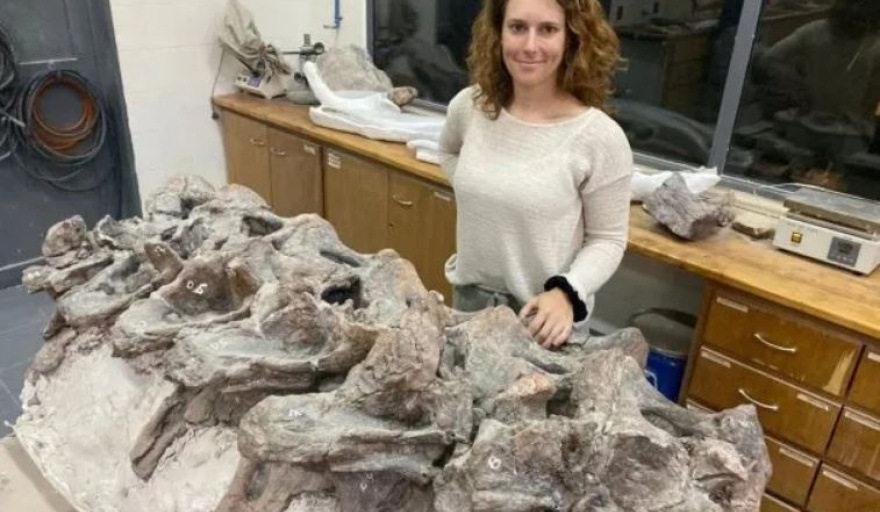
CONICET researchers have confirmed a historic find in Chubut Province: a new dinosaur species named Bicharracosaurus dionidei. Inhabiting the region over 150 million years ago, this discovery is a crucial link in the evolutionary history of sauropods.
-
The Species: A long-necked, long-tailed herbivorous sauropod from the Late Jurassic Period. It was identified via unique dorsal, sacral, and caudal vertebrae found in the Cañadón Calcáreo formation.
-
Evolutionary Key: The Bicharracosaurus holds an intermediate position in the sauropod lineage, helping scientists understand the transition from primitive forms to the giants that dominated the Cretaceous Period.
-
Unique Adaptation: The fossils reveal complex internal cavities in the vertebrae, suggesting that Patagonian sauropods followed a distinct evolutionary path compared to those in other parts of the world.
-
Local Tribute: The species name honors Dionide Mesa, who assisted in the initial identification of the remains.
Bottom Line: This find reaffirms Patagonia as a global paleontological powerhouse and highlights South America as a central hub for dinosaur evolution.
SOURCE: batimes.com.ar