
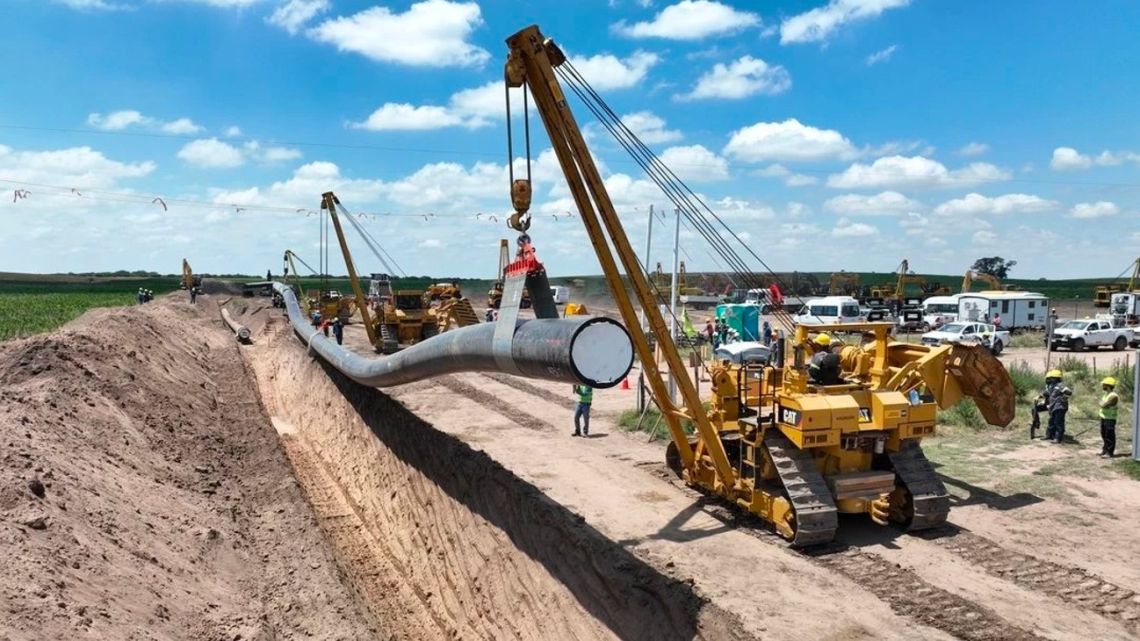
The CEOs of four leading energy companies debated at the Midstream & Gas Day, organised by EconoJournal, the most convenient medium-term strategies in terms of production and infrastructure, to take advantage of the hydrocarbon potential. What should be done with the increasing amounts of gas being extracted from Vaca Muerta and the Austral Basin? What is the potential of offshore exploitation? Should the reversal of the Gasoducto Norte be the next big goal after the inauguration of the first stage of the Néstor Kirchner pipeline? How many dollars could oil exports bring in the coming years? These were some of the questions that Javier Rielo (Total Energies), Javier Martínez Álvarez (Tenaris), Horacio Turri (Pampa Energía) and Daniel Ridelener (Transportadora Gas del Norte) sought to answer.
Reversion of the Northern Gas Pipeline
With the Néstor Kirchner pipeline only a few weeks away from being inaugurated, the focus was placed on the need to move forward with the reversion of the Northern Gas Pipeline. Daniel Rideneler said that TGN is already working in that direction. “When we talk about the reversion of the Northern Gas Pipeline, we do it in generic terms, but there are several projects that fit within that description. The first one is one that we are already carrying out, which increasing the reversion capacity by 3 million cubic metres. It is a decision we took a few months ago because, even with tariff restrictions, we are aware of the problems there may be this winter in supplying the north. We are going to finish this work in accordance with the completion of the Néstor Kirchner gas pipeline in June. These are gas pipeline retesting works and works within two compressor plants. The current capacity is 7 million and we are increasing it to 10 million. It seems a minor difference, but with the shortages we are going to have this winter, those 3 million can make the difference,” he said.
Offshore exploration
Javier Rielo gave details about the Fénix project that Total Austral is carrying out in the Austral Basin. “Fénix is progressing well. We already have more than 60% of the platform built. The idea is to finish the platform between October and December this year and, in January, we will bring it to the Argentine southern sea for installation. In August, we will see movements in the sea, because we are starting to lay the underwater pipeline that connects the platform we are going to install with Vega Pléyade. The two platforms will be connected and, then, all the gas extracted will be processed in the plants we have there. The project is on track. We believe it can be producing by the end of 2024, earlier than we had anticipated. Everything is working very well. We hope to continue along the same lines,” he said.
Focus on the region
Rielo also stressed that the key is selling energy to neighbouring countries. “The internal gas supply will be assured with the first inauguration of the Néstor Kirchner gas pipeline. We have to attack the regional market. These are not significant investments and we have a demand that can be supplied with a volume similar to that of the LNG plant that Petronas and YPF are considering,” he said.
Window for oil
Javier Martínez Álvarez, from Tenaris, said that crude oil exports should be boosted. “There is a tactical opportunity for oil. Today, certain stars are aligned. Russia is challenged in some markets and opportunities are opening up for Western countries. How big is this? Today, the Oldelval expansion, with its various stages, is being launched. In simplified terms, we can say that, by the end of next year, there will be 300,000 more barrels. Otasa will add another 100,000 barrels. Overall, there are 400,000 barrels per 365 days of the year for 70 dollars, which adds up to more than 10 billion dollars for Argentina,” he said.
SOURCE: econojournal.com.ar