
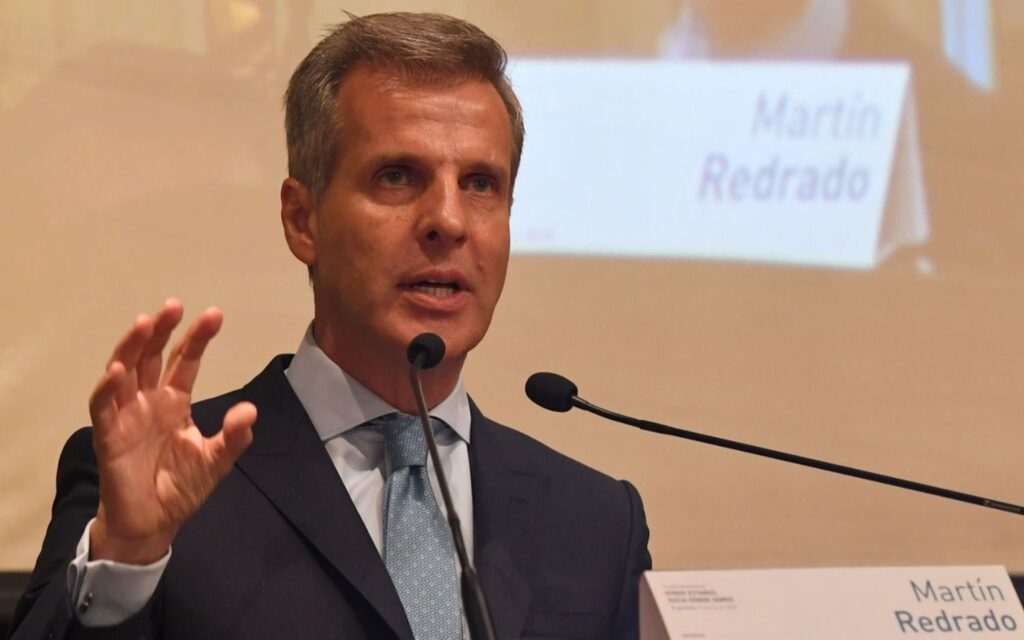
Once known in economic circles as the ‘golden boy’ (“chico de oro“), Martín Redrado headed the Argentine equivalent of the Securities and Exchange Commission (CNV, in its Spanish acronym) during the Carlos Menem Presidency and served as deputy foreign minister under Eduardo Duhalde. He took on the role of Central Bank governor during the Kirchner presidencies, heading the institution from 2004 to 2010 before a messy and controversial departure. Today, he works as Strategic Affairs Secretary for Buenos Aires City Mayor, Horacio Rodríguez Larreta, one of the opposition’s leading presidential candidates.
Redrado, 61, defines himself as an economist “transcending the grieta chasm” and speaks of the plan he is preparing with the City mayor, on whom he places all his bets as the next president.
“I am convinced that the train of history is again passing the platform of Argentina. And I tell you, this time, it’s worth it”.
The other day we were talking and he said: “Martín, either we transform or we’re out of here.” Argentina is at a point when we are without financing with all the Central Bank reserves gone, nobody lending us a dollar and all the pesos we’ve been able to scrape from the domestic market, gone. The only thing left to us is a Central Bank from which we ask each time coloured paper money which nobody wants with 100 percent inflation so that there is no margin for getting anything wrong. So he is called upon to present a package of six, seven or eight laws from the first day of his government, permitting us to change the reality of Argentina. Of course, he has a passion for asking after detail but we have seen in the City, even if many may say that the City is not the nation, but in many issues … What he has done in education, for example, our transformations really give a strategic vision. He obviously delegates to his ministers the capacity to carry out policies and he has the capacity to control his ministers, as a president should.
The relationship with Brazil is a priority and, of course, also with Uruguay and Paraguay, and over concrete issues such as, I’m convinced, energy integration, which is something over which we have often conversed with Horacio, who has especially asked me to look at the processes of integration with the rest of the region. This will permit us to change Argentina’s current dollar equation.
As you know, a gas pipeline running from Vaca Muerta through Tratayén to Salliqueló is being completed. Argentina needs multilateral financing – this is something we are looking at in the City and, I think, also should be transferred to the national level, such as how to finance the second stage to San Jerónimo near Rosario. And here reality gives us good news and bad news: Bolivia will be running out of gas next year so we must reverse the Transportadora de Gas del Norte pipeline running from Bolivia to Argentina, which has been selling us gas in recent years but also runs to São Paulo. Argentina must reverse this construction, as well as adapt the turbo-compression gas plants, because the gas pipelines are broader at the point of exit and narrower at the point of entry and because the gas is now going to go from Argentina to Bolivia. Some very tough negotiations with Bolivia lie ahead but this will permit us to give energy security to Brazil and advance in concrete issues.
In my judgement, as proposed by Fernando Henrique Cardoso, it is basic that we can form a common market between Argentina and Brazil where merchandise can come and go. Having technical standards will permit us greater integration because regionalisation is one of the global mega-trends since globalisation as we know it has ended. There is a trend towards fragmentation and regionalisation, towards replanting international relations. In my judgement the key to the relationship with Brazil will lie in concrete issues rather than thinking of mega-projects: physical and energy integration, common standards for our industrial products for more and better trade. The relationship with other countries should be discussed in depth with Brazil, our relationship with China, for example, and having a very serious policy of integration with those countries with whom we share values and common interests. Revaluing the Asian Pacific and the relationship with India seem fundamental to me.
Will Horacio Rodríguez Larreta become president?
I’m convinced that he has the capacity, the teams and the vision and I’m very enthused about working on this project because for me he is the one with the capacity to transform Argentina. I believe that we face a historic opportunity. There will be a good debate and, as you pointed out a while ago, you get there via agreements or via conflicts. I’m convinced and so is Horacio, which is why he recruited me into this team, that Argentine society has already had plenty of conflicts and that it does not want leaders and politicians who squabble.
Of course, you have to fight for the things in which you believe, with discussion. I had a professor of Macroeconomics in UBA [University of Buenos Aires] called Adolfo Donadine, I always remember him telling us: “Lads, when you take up a position, cross the street and discuss it.” Two things can happen to you there, either you change your mind or you cross back with your position even stronger. That is what the agreements are about, agreements leading to laws in Congress.
Horacio has demonstrated the capacity and vision to do it so we are facing a historic opportunity.
SOURCE: www.batimes.com.ar