
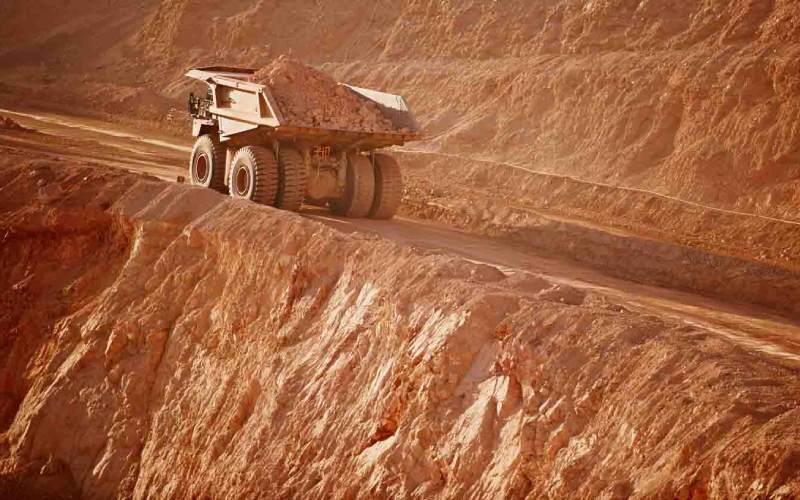
Global mining heavyweights including Lundin Mining Corp, Glencore Plc and First Quantum Minerals Ltd are piling into Argentina as a new government intent on luring foreign investment propels the companies closer than ever to opening up vast copper deposits in the red-hued Andes.
It’s part of a colossal wave of spending needed worldwide to prevent a supply crunch for the metal, a critical component of the electrification push to slow climate change.
Argentina stands to get a good share of that money if President Javier Milei can convince companies based in Toronto, Melbourne and London that their projects are safe from the country’s notoriously volatile politics and rules for doing business — and if those companies can convince Argentines that the economic benefits outweigh the environmental risks.
As it stands, Argentina produces next to no copper despite sharing geology with its neighbour Chile, the world’s top exporter.
But should just six of the two-dozen-or-so copper projects being contemplated in Argentina come to pass, the nation could be a major supplier by 2035, churning out more than one million metric tons a year. Annual exports could top US$8 billion, according to local mining group CAEM.
“With the change of government, I think Argentina will now become a huge rival to Chile,” said Marcelo Awad, who was the chief executive of Antofagasta Plc from 2004 to 2012 when the Chilean miner tried and failed to start operations in Argentina. “The pro-business policies clearly make it a big competitor for attracting capital flows to copper projects.”
Milei is trying to flip the fortunes of a country that’s on course for its sixth recession in a decade by curtailing government influence and freeing business from a slew of controls to — in theory, at least — tee up private-led growth. Former president Mauricio Macri tried something similar from 2015 to 2019, but the efforts didn’t make much progress and he was swiftly voted out.
To help avoid a repeat scenario, Milei needs to generate a surge in economic activity. Mining, one of just a handful of sectors with the muscle to stimulate business up and down Argentina, provides an obvious opportunity.
That’s why Milei has made a sweeping package of tax, currency and customs benefits for big-time investors — known locally by its Spanish acronym, RIGI — a hallmark of his proposed reforms. They’re being debated by lawmakers.
“The RIGI will be a jumper cable for infrastructure projects,” said Michael Meding, the general manager of Los Azules, a copper site run by Canada’s McEwen Copper Inc. Company officials estimate it will take US$2.5 billion to build the mine, with construction slated to start midway through Milei’s four-year term if it can win the needed permits.
Prices of copper, a wiring metal, have surged in recent months, driven in part by concerns that demand from clean power, military equipment and data centres will outstrip supply. Miners need to spend about US$130 billion over the next decade to avoid a projected annual shortfall in 2034 of some 7.7 million tons, according to the CRU Group, a research firm focused on mining and commodities.
While there’s plenty of copper still in the ground, deposits are getting pricier and trickier to develop at a time of heightened scrutiny of social and environmental issues. In Argentina, those issues have been a bigger hurdle than elsewhere — but the record prices and Milei’s pivot to a friendlier business climate are suddenly making it more feasible to unearth the nation’s resources.
Argentina has already had success with lithium, a mineral that’s key to making batteries for electric cars. Copper projects, though, tend to be bigger, more expensive and more destructive. And Argentina is a particularly precarious destination for prospectors since it is largely focused on farming and oil, not metals like regional peers Chile and Peru.”
SOURCE: www.batimes.com.ar